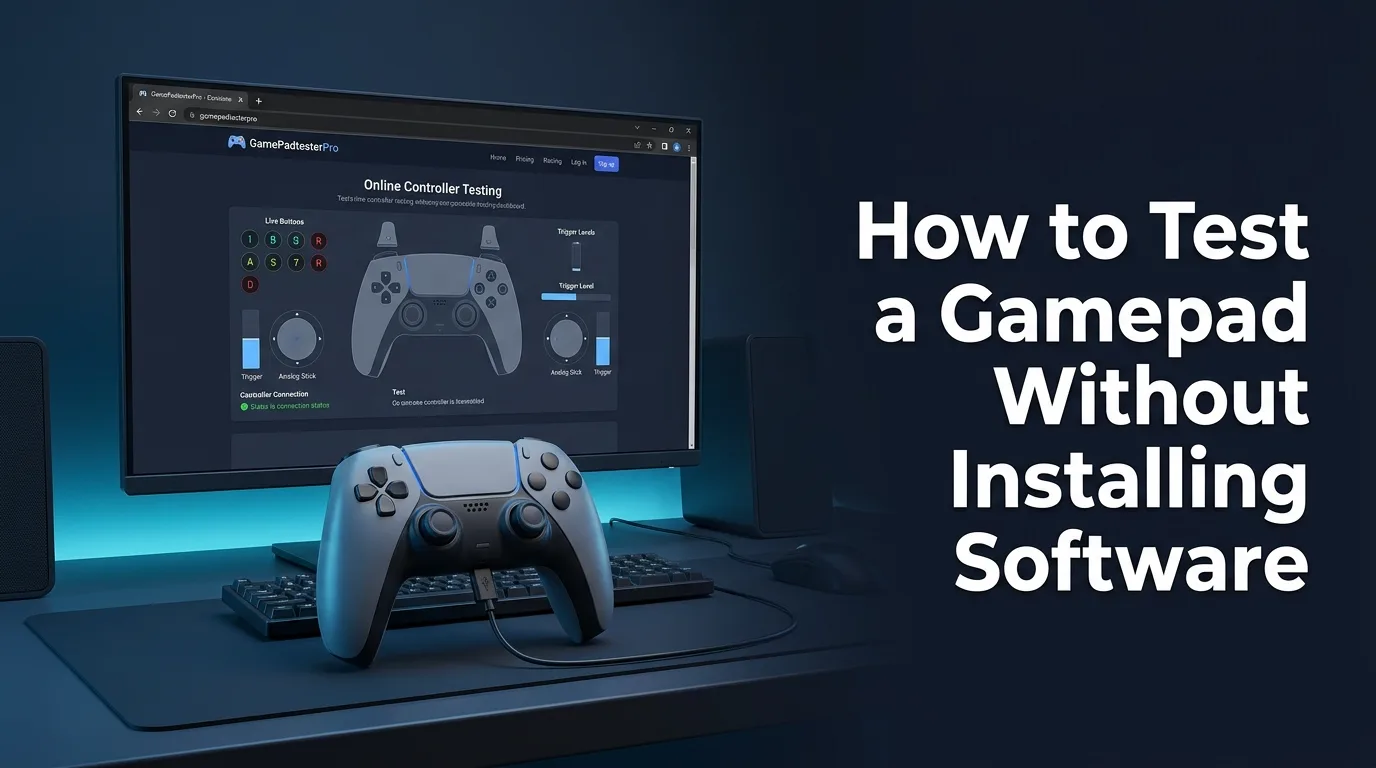
How to Test a Gamepad Without Installing Software — Use live Gamepad API readings to answer a specific controller question, with clear next steps instead of generic filler. No install required for the first pass. Open the matching Gamepad Tester panel, take two quiet samples, and write down the worst reading before you decide to clean, repair, or keep playing.
Hardware labs write down readings. Treat this page the same way: capture idle magnitude, button indexes, trigger travel, and connection type while you work through online gamepad test.
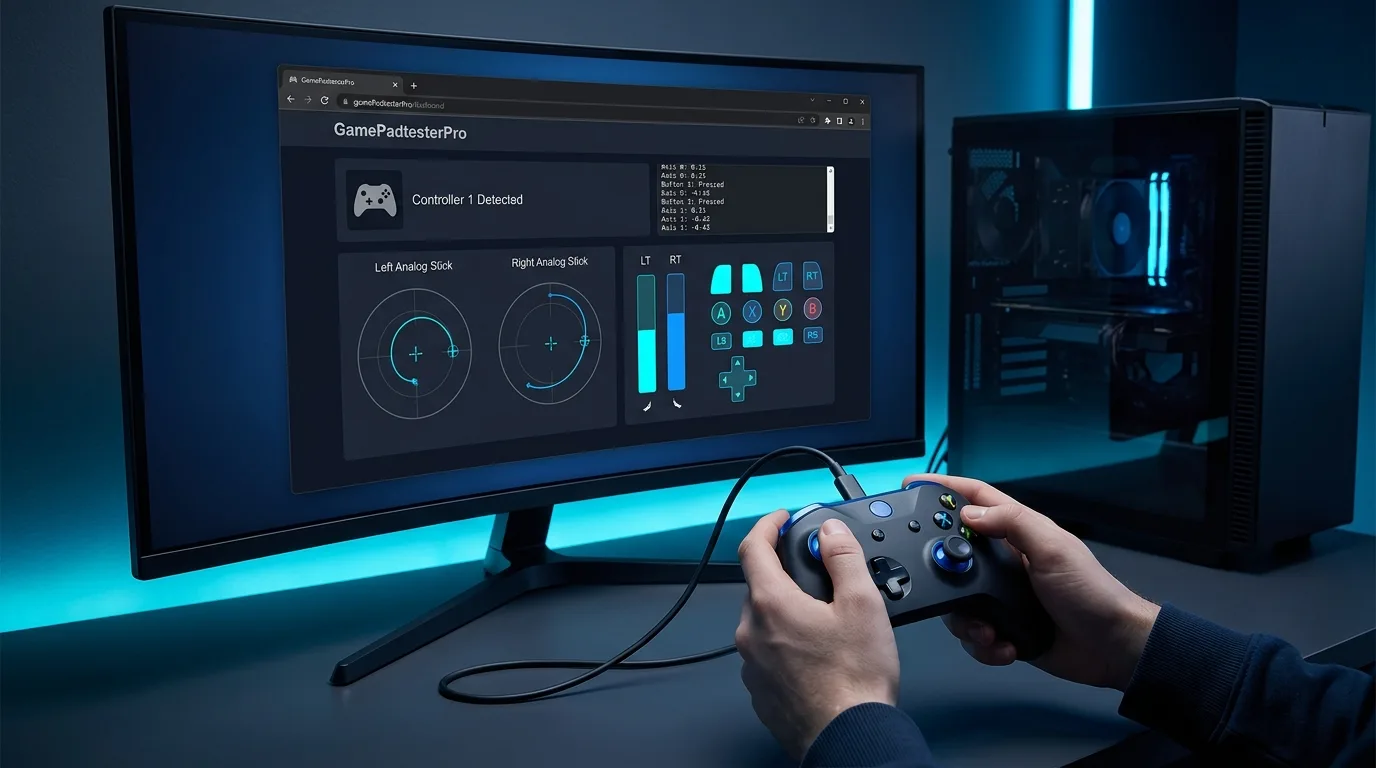
Diagram of the browser tester view for this workflow.
What checklist themes matter here?
You will set up detection, run the focused checks for this topic, interpret the live panels, and decide what to do next. Keep the session simple: one controller, one browser tab, and a clear goal for the check you are running.
- How to wake browser detection reliably
- Which Gamepad Tester panels matter for this intent
- How to avoid false positives
- What to try if results look unhealthy
What should you do before the first sample?
Use a desktop browser with Gamepad API support such as Chrome, Edge, or Firefox. Connect with USB for the cleanest baseline, or finish Bluetooth pairing in the OS first if you must test wireless. Close games, Discord overlays, and exclusive capture tools that can lock the device. Open Gamepad Tester or a focused tool below, then press any button so the browser wakes detection.
Recommended tools for this topic:
How do you complete the procedure?
- Connect the controller with USB or finish OS Bluetooth pairing.
- Open the matching Gamepad Tester tool from the list in this article.
- Press any button to make the browser list the device.
- Confirm name, mapping, button count, and axis count on the status card.
- Run the focused checks described below for this topic.
- Retest once over USB if wireless results look unstable.
Keep the tab visible while testing. Some browsers throttle background pages.
What does a clean readout mean?
Look for clean pressed and released states, smooth stick travel, sensible trigger range, and rumble only when the browser exposes an actuator. Missing rumble in the browser is not always broken motors. Take two or three samples a few minutes apart if the first reading surprises you. Consistency across samples matters more than a single scary spike.
Browser testers show what the Gamepad API exposes. A healthy reading is a strong signal, but it does not guarantee every native title will feel identical. On DualSense, Gamepad Tester can also use optional WebHID checks for touch pad drawing, adaptive trigger feel, speaker beep, and a simple PDF activity report when Chrome or Edge grants access over USB. Pair this page with Stick Drift Test, Vibration Test, and when you need permanent stick center or range writes, PS4 / PS5 Calibration.
What panels belong in a modern gamepad test?
The homepage Gamepad Tester and brand controller pages (PS5, PS4, Xbox, PC, USB, Bluetooth, arcade, flight) share one live dashboard. You get up to four controller slots, live sticks with circularity view, buttons, triggers, vibration pulses, optional DualSense touch pad and adaptive trigger checks, speaker or beep tests when supported, and a downloadable PDF summary after you exercise the pad.
- Four Gamepad API slots so a second, third, or fourth pad can connect without leaving the page.
- Stick reach / circularity visuals plus idle drift and deadzone explorers on focused tools.
- USB WebHID stick calibration for official DualShock 4 and DualSense pads when you need to write center or range after a module swap.
- Honest limits: browser rumble is not every native haptic, and Gamepad API alone cannot rewrite firmware maps.
What quick traps waste testing time?
- Cleaning with liquids that soak stick modules.
- Testing on a vibrating desk that moves idle samples.
- Stopping after one scary spike instead of three quiet samples.
Do not skip the reconnect step. Many flaky reports clear after a fresh plug in.
Which desktop browser practices keep samples honest?
On Windows, prefer a direct USB cable for first checks. If wireless is required, confirm the OS sees the pad before blaming the tester. Update controller firmware with official maker tools when available. After any repair, retest buttons, sticks, triggers, and rumble in that order. If the device never appears, start at Controller Detection before you open deeper panels.
Document your browser, connection type, and controller model when asking for help. That detail saves time. If results conflict between browsers, trust the clearer desktop Chromium session over a mobile browser.
What decision framework fits this topic?
If detection fails entirely, fix connection first. If detection works but one control family fails, focus repair there instead of replacing the whole pad immediately. When in doubt, capture a short note with date, browser, connection type, and the worst idle or button value you saw.
Aim assist and high deadzones hide symptoms in competitive games. Confirm with a quiet browser idle test instead.
Where do bare gamepad grids fall short?
A bare button grid helps for five seconds. Decision content plus links into Stick Drift, Detection, and Vibration is what users keep.
What are the most common questions?
Is an online tester accurate enough?
It is accurate for what the browser exposes, which is enough for most input and drift checks.
Do I need drivers?
Usually the OS already provides what the browser needs. Official firmware tools are separate.
Will this work on phones?
Support varies. Desktop browsers are more reliable.
How is this different from a basic gamepad tester?
You get the live tester plus a decision checklist, related tool links, and guidance for used buys and repairs.
Related Gamepad Tester guides
- How to Test a Controller on PC: Buttons, Sticks & Input
- How to Test Controller Input Lag and Input Delay
- How to Use a Gamepad Tester: Complete Guide
How do you continue testing from here?
Use the linked testers above, then compare with the homepage Gamepad Tester (four slots + DualSense extras), Stick Drift Test, Deadzone Test, Vibration Test, and PS4 / PS5 Calibration when you need WebHID stick writes after a hardware swap. Keep notes of idle magnitude, button indexes that fail, and whether USB behaves better than Bluetooth.
Bookmark the tools linked above and reuse them whenever online gamepad test comes up again after travel, repairs, or a used purchase.
How do you test buttons without installing anything?
Start on the Gamepad Tester home page or the Controller Tester page, press a button to wake detection, and then press every face button, shoulder button, and menu button one at a time. A healthy button lights up when pressed and clears cleanly when released, with no flicker and no button that stays stuck on the display. Work slowly through the D-pad as well, because a diagonal press should show two directions at once, while a single direction should never trigger its neighbor. If a button only works when you press hard or at an angle, note its name and position before you move on, since that pattern usually points to a worn contact or debris under the button rather than a browser problem.
How do you check sticks and deadzones in a browser?
Open the Stick Drift Test and the Deadzone Test, leave both sticks untouched, and watch the idle dot for at least thirty seconds. A rested stick should sit close to center, while a drifting stick creeps away on its own or rests off-center even when you are not touching it. Next, move each stick slowly in a full circle and look for a smooth, round path rather than a flat side, a jump, or a dead patch where movement stops. If small movements near the center do nothing in games, try the deadzone explorer to see how much travel is ignored before input registers, and compare that result with the PC Controller Tester view so you can tell a hardware fault from a game setting.
What can a browser test tell you about triggers and bumpers?
Triggers are analog controls, so a browser test should show them rising gradually from zero to full as you squeeze, not jumping straight to full or stalling partway. On the Gamepad Tester and Controller Tester panels, press each trigger slowly, hold it halfway, and then release it smoothly while you watch the bar or value change. A trigger that sticks at a low value, flickers at rest, or never reaches full travel may have a worn spring, a dirty sensor, or a damaged cable path. Bumpers, by contrast, should behave like clean digital buttons, so test them with quick taps and longer holds, and retest over USB if a wireless trigger looks noisy, because low battery and interference can mimic a failing trigger.
How do you test vibration without a downloaded app?
Use the Vibration Test, choose a short pulse first, and confirm that each motor responds on the side you expect. A healthy pad should start and stop cleanly, while a weak, rattling, or one-sided response can mean a loose motor, a worn mount, or a battery that cannot deliver a strong pulse. Keep in mind that browser vibration is limited to what the Gamepad API exposes, so a missing effect in the browser does not always mean the motor is broken in every game. If one side is silent, swap the test to the Gamepad Tester home page, try a longer pulse, and check whether the same side stays silent before you decide the pad needs repair.
How do you compare USB and Bluetooth results without software?
Test the same pad twice, once over USB and once over Bluetooth, using the USB Controller Tester view and the Bluetooth Controller Tester view, and keep the browser, the test order, and the pad in the same position for both runs. USB should give the steadiest baseline, while Bluetooth can add small delays, dropped presses, or noisier stick readings when the battery is low or another wireless device is nearby. If Bluetooth looks worse, charge the pad, move closer to the computer, and retest before blaming the hardware. If USB and Bluetooth both show the same stuck button or drifting stick, the fault is far more likely in the pad itself than in the connection.
What should you check on a used or borrowed pad without software?
Run a full no-install pass before you pay or borrow for long: buttons, both sticks, triggers, bumpers, and vibration, in that order, using the PS5 Controller Tester or Xbox Controller Tester view that matches the pad when one is available, or the general Gamepad Tester view for other models. Ask the seller to leave the pad untouched for the idle stick check, then watch for drift, a sticky button, or a trigger that never reaches full travel. Write down the model, connection type, and any failing control, and compare the same pad on a second browser if a result looks odd, so a browser quirk is not mistaken for a hardware fault.
More questions about testing without installing software
Can a browser tester find input lag without software?
It can reveal obvious delay and dropped presses, and the Input Lag Test gives a useful comparison between pads and connections, but it cannot replace a controlled native measurement. Keep the test conditions the same, use USB for the baseline, and treat small differences as indicative rather than exact.
Why does my pad appear in one browser but not another?
Browsers differ in Gamepad API support, permissions, and how they handle background tabs, and another app may already hold the pad exclusively. Try Chrome or Edge first, keep the tester tab in the foreground, close game launchers and overlays, and start at Controller Detection if the pad still does not appear.
Is it safe to test a borrowed controller in a browser?
Yes, a browser tester only reads what the Gamepad API exposes and does not install drivers or change firmware. Avoid granting extra permissions you do not need, and use PS4 / PS5 Calibration only when you understand that its WebHID step is meant to write stick center or range values.
What should I do if only one stick drifts in the browser?
Retest that stick over USB, on a flat surface, and after a fresh reconnect, then check the same stick in the Stick Drift Test and Deadzone Test. If the drift follows the stick across connections and browsers, it is likely hardware wear; if it disappears on USB, suspect battery, interference, or a wireless fault first.
Comments
Comments are moderated. New comments stay hidden until an admin approves them.
No public comments yet. Be the first to leave a helpful note.